Blog
A recent ABA panel of class action experts discussed the surprising resurgence of state court class actions despite the federal 2005 Class Action Fairness Act’s (‘CAFA’s”) efforts to rein in state court class action over the last 20 years.
Whether you represent the plaintiff or the defendant, always check the professional’s “Claims Made & Reported” policy in effect at the time of the incident—especially if the defendant retired soon after. A slightly higher premium may have purchased a Tail Coverage Endorsement, extending protection for several years beyond the policy’s expiration. Discovering that coverage early can change the outcome for both sides and make the case ideal for early mediation.
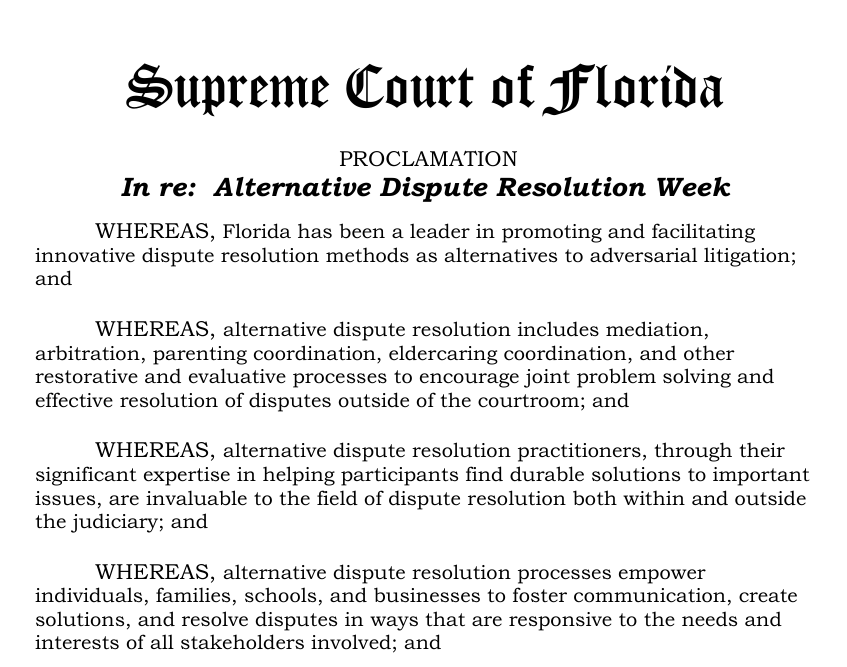
This year, Florida's ADR Week is observed October 12 – 18, 2025, with the theme:
“Resolve to Evolve: Embrace ADR for a Harmonious Tomorrow.”
The Court’s official proclamation commends mediators, arbitrators and other neutrals for helping Floridians resolve disputes in ways that conserve judicial resources and foster communication, understanding, and lasting agreement.

Three times seems to be the charm for the 11th Circuit, which recently revisited for the third time the proposed $35 million nationwide TCPA settlement at issue in Drazen v. GoDaddy.
This issue is treated as an affirmative defense, meaning that it is usually a jury issue in which each side must prove its point. This adds a lot of expense and risk to cases, beginning at the summary judgment stage and especially if the issue goes to trial.
The 11th Circuit reversed the district court (and magistrate judge’s recommendation) and held – at least for alleged violations of the Fair Credit Reporting Act – that the mere alleged statutory violation itself is a “concrete injury” akin to the traditional harm of publishing defamatory information.
In Lowery v. Rhapsody International, Inc., the Ninth Circuit reversed a $1.7 million fee award in a claims-made class settlement because only $53,000 in class benefits were distributed, despite $20 million in benefits being available.
We will be closely monitoring this fast-changing legal landscape and updating our readers on future developments.
This procedural maneuver, unique to Texas, permits corporations to split into two new companies, one that holds only mass-tort related liabilities (in J&J’s case all talc-related liabilities) and another that holds non-talc assets and liabilities."